
Menu
University research directory
Research labs at
University of California, Los Angeles.
Compare 5 listed faculty-led profiles, explore their research interests, and follow the evidence in their selected work. These listings are a starting point for discovery and do not establish recruiting availability.
Explore the research before reaching out
Review each lab’s official website and recent publications. Compare the methods used, the questions being asked, and the practical requirements of any published opening. Unclaimed profiles are independently curated; the university has not approved or endorsed them.
How to compare research labs ↗Official university website ↗5 research-led lab profiles
Browse labs by their listed college affiliationAlvaro Sagasti Research Group
University of California, Los Angeles
Alvaro Sagasti · Professor, Molecular, Cell and Developmental Biology
How do skin cells and peripheral sensory axons acquire their shapes and interactions during development and repair? The Sagasti lab uses zebrafish embryos and larvae to image morphogenesis of skin cells and sensory neurons in vivo. The group employs transgenic lines, live-cell imaging and laser-based ablation to study peripheral axon branching and regenerative repair mechanisms. Researchers combine genetic manipulations and molecular markers to identify pathways controlling cell shape and axon targeting. Comparative injury studies probe how cellular morphogenesis is altered by damage to reveal repair mechanisms.
 Independently curated · Unclaimed
Amander T. Clark Research Group
University of California, Los AngelesAmander T. Clark · Professor, Molecular Cell and Developmental Biology
Can human pluripotent stem cells be guided to form germ cells and ovarian tissues in vitro? The Clark Lab uses stem cell models and genome-scale assays to define cell and molecular origins of the ovarian reserve and primordial germ cells. The group applies single-cell analysis, genome engineering and machine learning to map lineage decisions and epigenetic reprogramming during germline specification. Researchers perform in vitro differentiation, transplantation and organoid-type reconstitution experiments to test mechanisms of gametogenesis and ovarian assembly. Comparative studies in primate and rodent systems validate developmental mechanisms relevant to fertility and ovarian aging.
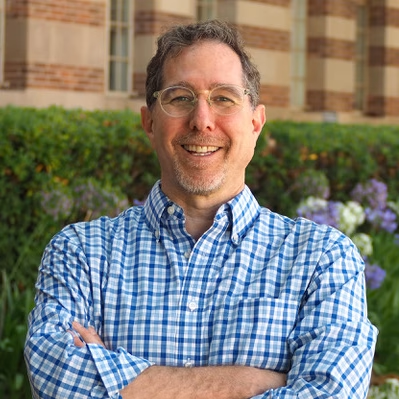
Jingyi Jessica Li Research Group
University of California, Los AngelesJingyi Jessica Li · Professor of Statistics and Data Science
How can statistical models reveal which molecular processes drive cell-to-cell transcriptome variation across populations and within single cells? The research group develops interpretable statistical methods for biomedical data, building tools that quantify regulatory mechanisms across transcriptomes. The group extracts hidden information from transcriptomics data by designing algorithms and simulators to evaluate data-generation assumptions and benchmarking analysis workflows. Researchers construct synthetic negative controls and other statistical controls to ensure rigor and control false discoveries in high-throughput analyses. The group implements and releases software (for example, scDesign3) to simulate realistic single-cell and spatial omics data for method evaluation and experimental design.
 Independently curated · Unclaimed
Jonathan Aurnou Research Group
University of California, Los AngelesJonathan Aurnou · Department Chair & Professor
How do rotating convection and magnetoturbulence produce planetary magnetic fields and jet structures? Aurnou’s group conducts laboratory experiments that emulate planetary core and atmosphere flows to observe rotating turbulence and magnetoconvection. The group develops numerical simulations to extend laboratory results and test dynamo and transport hypotheses under planetary parameter regimes. Researchers formulate theoretical models from combined experimental and numerical data to identify mechanisms of heat transfer, jet formation and magnetic field generation. Diagnostic methods include velocimetry, thermometry and magnetics to quantify flow dynamics and to compare with theoretical predictions.
 Independently curated · Unclaimed
Kunihiko (Sam) Taira Research Group
University of California, Los AngelesKunihiko (Sam) Taira · Professor / Vice Chair Industry Relations and Outreach
How can data-driven models enable control of unsteady fluid flows for practical engineering systems? The Taira Lab develops high-performance computational fluid dynamics models that combine fluid mechanics and dynamical systems theory to analyze flow structures. The group applies network science and data science to identify coherent flow mechanisms and reduced-order representations useful for flow control design. Researchers use large-scale numerical simulation and high-performance computing to test control strategies and to derive interpretable models of unsteady aerodynamic forces. Experimental and computational validation are used to evaluate control performance and to connect mechanisms to engineering applications.
Showing 1–5 of 5 labs